


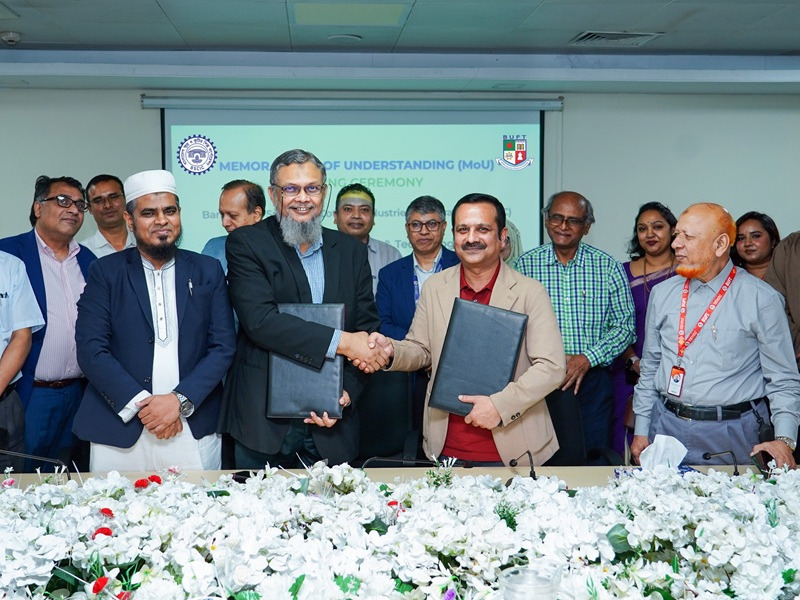
BSCIC and BUFT Sign MoU to Modernize Traditional Crafts and Cottage Industries
Bangladesh Small and Cottage Industries Corporation (BSCIC) and BGMEA University of Fashion & Technology (BUFT) signed a Memorandum of Understanding (MoU) on October 8, 2026, to accelerate the modernization of Bangladesh’s traditional crafts and cottage industries through design innovation, technological advancement, intellectual property protection and market-driven product development. The partnership seeks to bring academic expertise and contemporary design capabilities closer to grassroots artisans while strengthening BSCIC’s institutional support for the country’s traditional craft sector. Under the MoU, the two institutions will collaborate to modernize BSCIC’s Design Centre’s through updated curricula, fashion and color forecasting, and computer-aided design (CAD) facilities. BUFT faculty members will also serve as resource persons in BSCIC’s training and capacity-building programs.
The signing ceremony was attended by BSCIC Chairman Benzir Ahmed and senior officials, along with BUFT Acting Pro-Vice-Chancellor and Treasurer Prof. Dr. Md. Alamgir Hossain, deans, faculty members and officials. The MoU was signed by BSCIC Director (Administration) Mr. Muhammad Kamruzzaman and BUFT Vice-Chancellor Prof. Dr. Engr. Ayub Nabi Khan on behalf of their respective institutions. The collaboration will also promote intellectual property protection and commercialization of products developed by small and cottage industry clusters. Through BUFT’s WIPO Technology and Innovation Support Centre (TISC), artisans and entrepreneurs will receive support in prior-art searches, industrial design registration and trademark protection.
The initiative is expected to foster innovative and market-responsive craft products, enhance the livelihoods of artisans and entrepreneurs, and strengthen the presence of Bangladeshi traditional crafts in both domestic and international markets. The MoU will remain effective for three years and may be extended by mutual consent. A joint steering committee comprising representatives from both institutions will oversee implementation, identify priority areas and regularly review the progress of the collaboration.